If you're building a simple customer support chatbot that answers company policy questions, LangChain is usually enough. The problem is that most enterprise AI systems stop being "simple" much faster than teams expect.
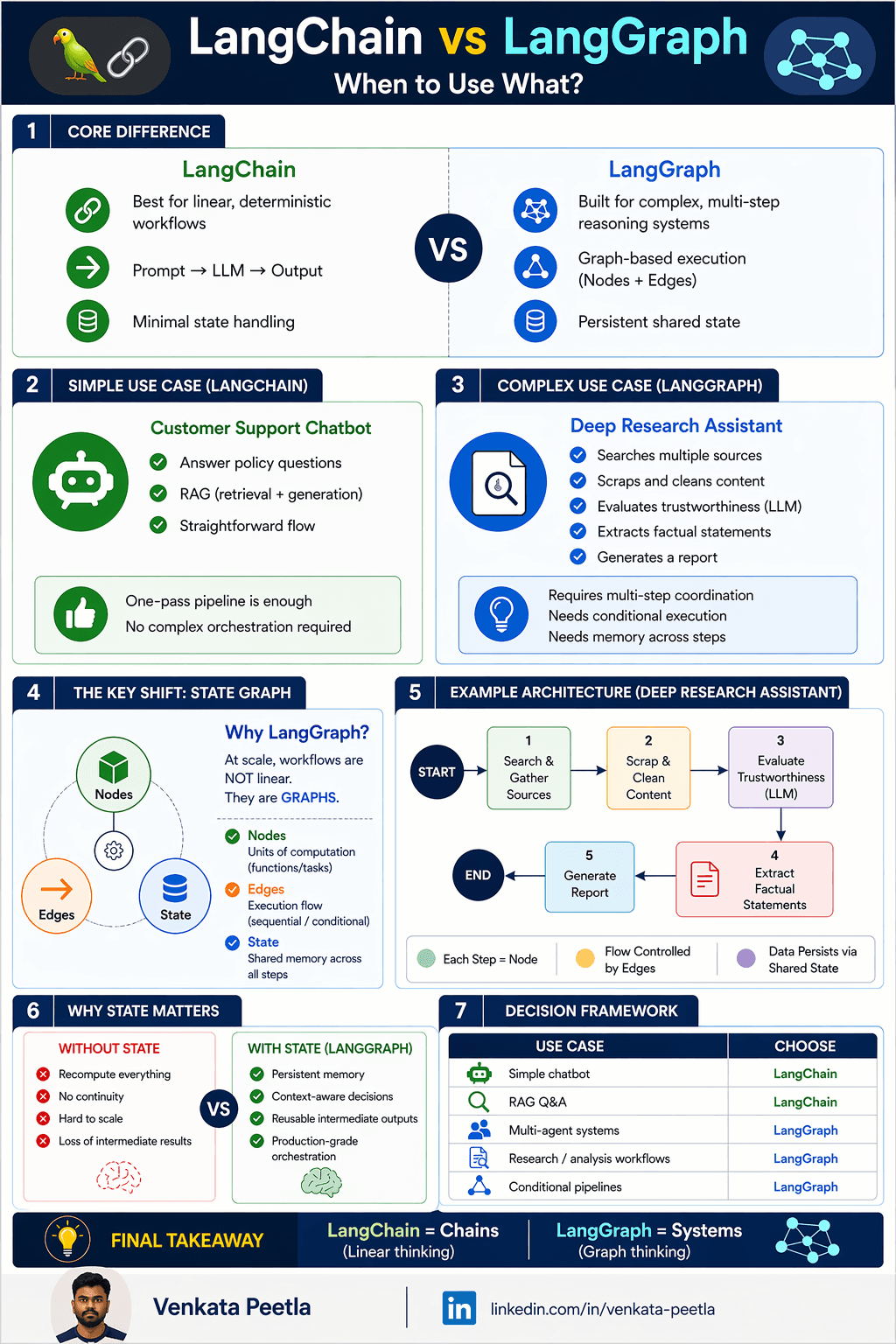
A simple way to visualize the shift from linear prompt pipelines to stateful system orchestration.
The easy answer
LangChain works well for:
- linear workflows
- deterministic outputs
- simple RAG pipelines
If your application is essentially:
- take input
- retrieve context
- generate answer
- return result
then LangChain is more than enough.
That is why it remains such a good fit for support bots, FAQ assistants, and lightweight internal tools.
Where the abstraction breaks
Real enterprise systems rarely stay linear.
Imagine building a deep research assistant that needs to:
- search across multiple sources
- clean and normalize content
- evaluate trustworthiness with LLMs
- extract facts and contradictions
- produce a final report
That is not a single chain.
That is a system of coordinated tasks with shared context, multiple execution paths, and intermediate decisions that affect later stages.
This is the moment where many teams keep using LangChain longer than they should. The system gets more complex, but the mental model stays too simple.
Why LangGraph changes the design conversation
LangGraph introduces a more useful abstraction for systems that are stateful and coordinated.
At its core is the idea of a state graph:
- Nodes are units of computation
- Edges define execution flow
- State is shared memory across the workflow
That changes the architecture from a prompt pipeline into a workflow engine for intelligent operations.
Instead of thinking:
call prompt A, then prompt B, then prompt C
you start thinking:
what state does the system hold, which node should execute next, and what conditions change the path?
That is a much better model for research systems, multi-step evaluators, and enterprise agents.
The real shift
The difference is not just library syntax. It is architectural intent.
- LangChain is strong for prompt orchestration.
- LangGraph is strong for system orchestration.
That is why I frame the decision this way:
- If your workflow is linear, use LangChain.
- If it is multi-step, stateful, and conditional, use LangGraph.
A practical rule I use
The moment your system needs:
- memory
- branching
- coordination
you are no longer building a chain.
You are building a graph.
That is usually the moment the wrong abstraction starts costing you time.
What teams often miss
The mistake is not adopting LangChain. The mistake is refusing to leave it once the workflow has clearly evolved into a coordinated system.
You can often spot that transition when the team starts asking questions like:
- How do we retry only one failed branch?
- How do we keep shared state between tool steps?
- How do we route different task types to different flows?
- How do we inspect execution history across multiple stages?
Those are graph questions, not chain questions.
Enterprise lens
In enterprise environments, systems usually need:
- explicit state handling
- recoverable execution paths
- branching logic
- visibility into intermediate steps
- clearer orchestration boundaries
That is where LangGraph becomes much more compelling. It maps better to how real systems behave once reliability, governance, and coordination matter.
Final takeaway
LangChain is not the wrong tool.
It is the wrong abstraction when the system has already become stateful, conditional, and coordinated.
For simple assistants, keep it simple.
For research systems, orchestrated agents, or enterprise workflows with multiple decisions and branches, move to the graph model earlier than you think you need to.
That shift usually saves more architectural pain than people expect.