My first post as an AI Architect focused on a practical question: how do we build a modular multi-agent system that is scalable, observable, and still affordable enough to experiment with quickly?
Why I wrote this
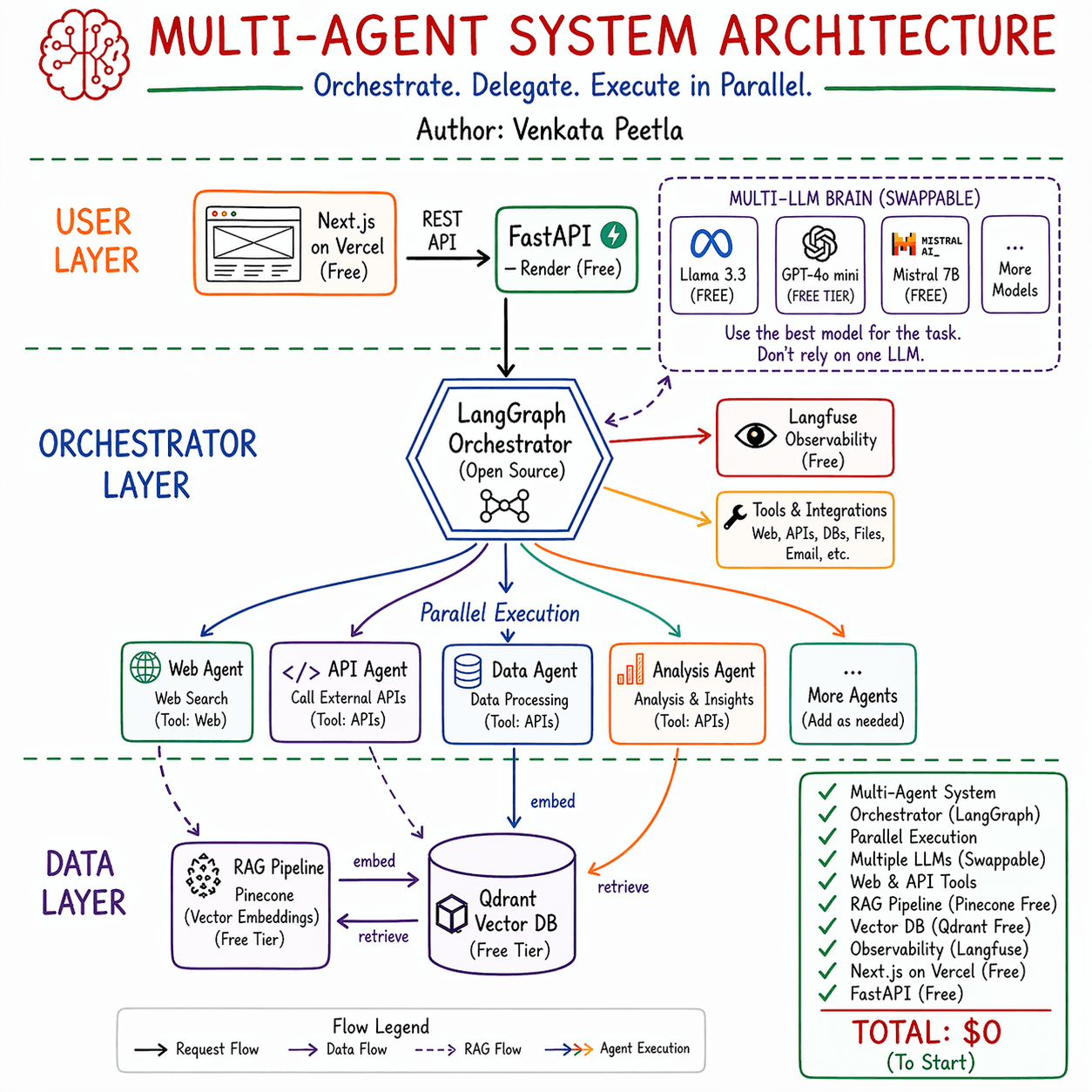
I wanted to share something I have been actively designing and building: a multi-agent AI architecture that is modular, scalable, and realistic to prototype on mostly free-tier tools.
The core idea is simple:
Don't rely on one LLM. Orchestrate multiple specialized agents.
That shift changes the system design conversation. Instead of forcing a single model to handle every responsibility, you can let an orchestrator delegate work to focused agents that each do one thing well.
Architecture highlights
- Brain (LLM): Llama 3.3 on the free tier, with room to swap in GPT-4o mini, Mistral, or other models.
- Orchestration: LangGraph for delegation, stateful flow control, and parallel execution.
- Agents: Web agent, API agent, Data agent, and Analysis agent.
- Execution model: Parallel task delegation instead of one long single-agent chain.
Data and RAG layer
- RAG pipeline: Pinecone on the free tier.
- Vector database: Qdrant on the free tier.
- Embeddings: Cohere Embed or open alternatives.
- Outcome: Better long-term memory, context-aware responses, and retrieval-backed reasoning.
This layer matters because multi-agent systems become far more valuable when they can ground their responses in external knowledge rather than only relying on the prompt window.
Observability and operational visibility
I included Langfuse for tracing, debugging, and improving agent workflows over time.
For agent systems, observability is not optional. Once you start delegating tasks and running steps in parallel, you need to understand:
- which agent handled which task
- where latency came from
- where tool calls failed
- what retrieval context influenced the result
User and delivery layer
- Frontend: Next.js
- Deployment: Vercel free tier
- Backend APIs: FastAPI
This setup keeps the system practical. You get a clean frontend, a lightweight API layer, and a solid base for future expansion without taking on unnecessary infrastructure cost on day one.
Why multi-agent instead of single-LLM
Single LLM systems hit limits quickly:
- context overload
- lack of specialization
- weak tool utilization
- harder debugging when everything is collapsed into one chain
Multi-agent systems improve that by:
- delegating tasks
- running in parallel
- increasing modularity
- improving reliability and scale
In practice, this means the architecture is easier to evolve. You can add or replace agents, tune specific behaviors, and introduce better tooling without redesigning the entire system every time.
Key takeaway
You can build a strong AI system today with:
- orchestration
- RAG
- observability
- multi-agent collaboration
And you can still keep the initial cost effectively at $0 to start.
From prototype to production: the hidden traps
The architecture is intentionally cost-efficient, but the real complexity shows up when you move from a working demo to a production system. That transition is where multi-agent stacks usually become either impressive or painful.
Here are the implementation issues that matter most in practice.
1. The hidden cost of "free" in the multi-LLM brain
At first glance, the challenge looks like model price:
- Llama 3.3 on the free tier
- GPT-4o mini on the free tier or low-cost tier
- Mistral or another lightweight alternative
But the harder engineering problem is context window management across heterogeneous models.
Imagine this flow:
- the Web Agent pulls a large body of search content
- the Data Agent produces structured output
- the Analysis Agent needs both of those inputs together
If every model expects data in slightly different shapes, the orchestrator becomes the glue layer. You can no longer rely on casually passing raw strings between agents.
The deeper lesson is this:
Multi-agent systems need an LLM-agnostic serialization strategy.
That can mean:
- strict
TypedDictor Pydantic-style contracts - normalized JSON payloads between nodes
- an MCP-style boundary for tool and state exchange
LangGraph gives you state management, but the quality of the system depends on whether agent outputs remain predictable enough for the next model in the chain.
2. The orchestrator layer latency trap
Parallel execution is one of the biggest reasons to move to multi-agent design, but it is also one of the easiest things to misunderstand.
If your FastAPI backend runs on a free-tier service that scales to zero, what you often get is not true compute parallelism. You get concurrent I/O waiting.
That distinction matters:
- a Web Agent may return in under a second
- an API Agent may wait on a third-party call
- an Analysis Agent may take several seconds on a higher-capability model
Even if the orchestrator fans them out in parallel, the user only sees the slowest path.
This means production-grade orchestrators usually need:
- timeout controls
- fallback logic
- cancellation strategy
- speculative execution for slower branches
Parallel fan-out is helpful, but without latency controls it can still produce a slow user experience.
3. RAG and Qdrant on the free tier: the stateful elephant
The RAG layer looks inexpensive on paper, but stateful infrastructure introduces its own operational tradeoffs.
- Qdrant free tier often means a very small cloud footprint or a local setup with strict limits.
- Pinecone serverless can introduce cold-start delays.
- Frontend or edge timeouts become real once retrieval latency and model latency stack together.
This is where many otherwise good prototype diagrams miss a critical component: caching.
If I were evolving this architecture for production readiness, I would strongly consider a cache layer for:
- embedding reuse
- hot queries
- common retrieval results
- stable analysis results for repeated prompts
A lightweight cache can remove avoidable vector lookups and make the system feel dramatically faster without changing the core architecture.
4. Observability is not optional in a multi-agent system
In a single-LLM application, tracing is helpful. In a multi-agent system, tracing is mandatory.
When something fails, you need to answer questions like:
- Did the Web Agent time out?
- Did the orchestrator choose the wrong branch?
- Did the API Agent return malformed JSON?
- Did the Analysis Agent hallucinate because retrieval came back weak?
This is why observability tools such as Langfuse matter so much. They give you the ability to inspect the execution tree rather than only looking at a final answer and guessing what went wrong.
In real implementations, one of the most useful practices is mapping orchestration runs clearly across systems:
- orchestrator run ID
- model call ID
- trace ID
- user feedback event
Without that, debugging becomes detective work.
5. The "more agents" scalability ceiling
Adding more agents sounds like a straightforward scaling path, but orchestration complexity rises faster than most teams expect.
At a small scale, a supervisor can choose between a few well-defined tools:
- Web
- API
- Data
- Analysis
At a larger scale, the routing decision itself becomes noisy. Once the supervisor is trying to reason over too many options, task misrouting increases.
That is usually the point where the architecture needs to evolve into hierarchical orchestration.
Instead of one global supervisor making every decision, you split the problem into smaller orchestration domains:
- a data-fetcher subgraph
- a research subgraph
- an analysis subgraph
- a communication or action subgraph
That reduces cognitive load on the main router and keeps the system more composable as it grows.
Readiness assessment
This kind of stack is absolutely strong enough for a demo, internal platform, or early-stage product.
My view is:
- Single LLM apps are easier to build at the start, but harder to scale cleanly.
- Multi-agent systems are harder to debug at the beginning, but far more robust once the architecture is disciplined.
The architecture pattern is solid. What determines long-term success is not just the diagram, but the rigor around state, routing, observability, and latency control.
The real decision problem: routing
The most important question in this architecture is not whether multiple models are available. It is whether the system can route to the right one at the right time.
That routing decision determines whether the multi-agent design actually saves money and improves quality, or just creates a slower and more expensive tangle of API calls.
In a single-LLM app, the path is simple: invoke the model and move on.
In a multi-LLM architecture, the orchestrator has to decide:
- Should this task go to the cheapest model?
- Should it go to the model with the strongest tool-calling behavior?
- Should it go to the model best suited for reasoning?
That is the meta-decision problem behind the entire stack.
Level 1: static routing by agent type
The simplest production-safe strategy is static routing.
You pin models based on the type of work each agent performs:
- Web Agent: low-cost summarization and extraction
- API Agent: stricter schema-focused model for structured outputs
- Data Agent: a code-oriented or transformation-friendly model
- Analysis Agent: the higher-quality reasoning model where mistakes are more expensive
This works because it removes ambiguity early. You are not yet trying to make the router intelligent. You are making it predictable.
The right way to evaluate this stage is through operational reports:
- JSON parse error rate
- schema violation rate
- latency per agent
- success and retry frequency
If the API Agent starts failing validation too often on a cheaper model, you stop debating and pin it permanently to the stronger one.
Level 2: confidence-based routing
The next step is routing by complexity rather than only by agent label.
Not every analysis task deserves an expensive model. Some are simple summaries. Others require real synthesis, contradiction handling, or forecasting.
At this stage, a router node can classify tasks into buckets such as:
- simple
- moderate
- complex
The implementation does not need to be fancy. A tiny classifier or a lightweight prompt-based router is often enough.
The evaluation loop matters more than the initial router:
- users provide feedback through regeneration or thumbs down
- traces are captured in observability tooling
- weak outcomes are reviewed by model and task type
- router rules are tightened over time
That is how a routing layer gets better in practice: not through theory, but through repeated observation of failure patterns.
Level 3: cost-aware optimization
Eventually, the routing question becomes a tradeoff problem:
- cost
- accuracy
- latency
At that point, the goal is not to pick the "best" model in isolation. It is to pick the Pareto-optimal model for the task.
The most practical way to do this is with historical replay:
- take real production queries
- replay them through alternative model routes
- compare output quality, latency, and cost
- update routing rules based on the actual deltas
This gives you evidence for choices like:
- keep email drafting on the cheaper model
- force structured generation to the stronger schema model
- reserve higher-end reasoning models for the hardest analysis paths
That is how routing evolves from intuition into a measurable operating discipline.
Level 4: dynamic thresholds
The most advanced version of this pattern assigns a complexity score instead of a binary route.
For example:
- score 1-4: free or low-cost model
- score 5-7: mid-tier reasoning model
- score 8-10: highest-capability model
The point is not the exact numbers. The point is that the threshold can move over time based on observed outcomes.
If score-6 tasks are failing too often on a lower-cost model, the system shifts them upward. If a cheaper model improves enough to handle a category well, the route moves back down and saves budget.
That is the long-term operating advantage of a well-designed multi-agent system: routing becomes a tunable business lever, not just a technical configuration.
Final perspective
If I had to summarize the whole architecture in one line, it would be this:
The stack is solid. The router is the profit margin.
The diagram shows how to get started with orchestration, RAG, observability, and multi-agent execution on an extremely cost-efficient stack.
The next layer of maturity comes from learning how to:
- control latency
- stabilize agent state
- validate structured outputs
- observe execution trees
- and continuously refine routing decisions over time
That is where multi-agent architecture stops being a prototype pattern and starts becoming a real operating model.
Where this goes next
This post is really the starting point. The more interesting work happens after the diagram:
- production hardening
- evaluation and safety controls
- enterprise integration patterns
- governance and security boundaries
- scaling multi-agent systems beyond prototypes
I'll keep sharing more on:
- real-world implementations
- enterprise AI patterns
- scaling multi-agent systems
Discussion prompt
If you're exploring AI architecture right now, are you still building around a single LLM app, or are you starting to design around multi-agent systems with orchestration and specialization?